We're the LiteFolio team. Have you ever gone back and asked yourself "wait, why did I buy this?" without ever having written down the reason? You forget why you bought a stock much faster than you'd expect. In this article, the LiteFolio team walks through a simple template for logging why you bought, and the moments when it's worth rereading.
Log why you bought and your expected scenario for every trade
See LiteFolioYou forget why you bought a stock faster than you'd think
The short version: unless you write it down, you're almost certain to forget why you bought a stock. The reason is simple — the information behind your decision only ever existed in your head at the moment you bought, and the longer time passes, the more it gets overwritten by new news and other information. Very few people can accurately recall, weeks later, exactly why they picked a given ticker.
It gets even trickier once you're sitting on an unrealized loss. Because people have a psychological pull toward justifying their own decisions, the original reason for buying can get quietly rewritten into an excuse for the loss. What started as "I thought it was undervalued" slowly turns into "this is a stock I should hold for the long run" — and the decision to cut your losses keeps getting pushed further and further out.
This memory drift doesn't happen because of weak willpower. It happens because human memory itself is naturally reconstructed after the fact, in whatever way is most convenient. That's exactly why locking in your reason for buying at the moment you buy is the foundation for a review process that isn't hijacked by emotion.
How to write an investment journal: a 4-field template
Writing an investment journal doesn't need to be complicated. Jot down a single line for each of the following four fields every time you buy, and reading them back later brings your decision at the time right back into focus.
"Trigger" and "rationale" capture why you bought in fact-based terms. Was it a strong earnings report, industry news, or just a ticker you'd had your eye on? Writing the trigger and the rationale as two separate lines lets you check for yourself later whether the trade was a snap decision or something backed by real research.
"Expected scenario" and "exit condition" are forward-looking benchmarks. Writing down "what would make me sell" at the moment you buy keeps you from having to invent that threshold in a panic once you're already sitting on a loss — exactly the moment your judgment is most likely to be distorted. All four fields can be one sentence each. A perfectly worded entry matters far less than jotting something down right after you buy.
This isn't a place to record the "right answer"
The point of an investment journal isn't to grade whether your call was right or wrong — it's to preserve what you were actually thinking at the time in a form you can check later. Even a reason that turned out to be wrong is worth keeping exactly as written.
When to reread it: at earnings and at the sale
A journal only has value once you actually reread it on a regular schedule — writing it isn't the end. The easiest moment to build a review habit around is whenever a stock you hold reports earnings. Make a habit of opening your investment journal each time earnings come out and checking "is this playing out like the expected scenario?" and "has the assumption behind my rationale broken down?" — it makes you far less likely to get whipsawed by day-to-day price swings.
The other key moment is right after you sell. Reread the entry immediately after selling and ask whether you sold according to your exit condition, and how far the outcome drifted from your expected scenario. Stack up enough of these reviews, and you build a growing bank of judgment you can draw on the next time a similar situation comes up.
Beyond earnings and sales, rereading your entries whenever a stock moves sharply, or on your own cadence — quarterly, say — works too. What matters just as much as writing the entry is deciding in advance when you'll reread it. A journal entry with no scheduled review just sits there, written and forgotten.
Comparing where to keep your journal: notebook, spreadsheet, app
Where you keep your investment journal breaks down into the same three options: notebook, spreadsheet, and app. Any of them lets you "write it down," but how easy it is to stick with depends on whether the entry stays linked to the trade it belongs to and how easy it is to find later.
Notebook
The biggest advantage is being able to write the moment the thought strikes you. The downside is that finding which entry goes with which trade later is hard, and the more tickers you follow, the more likely you are to end up thinking "where did I write that note again?"
Spreadsheet
Combine your trade history and a notes column into one table, and searching and sorting make it easier to reread than a notebook. But as covered in our stock portfolio spreadsheet template guide, the effort of entering and tallying the trade data itself is still there, so the barrier to keeping the journal habit going doesn't really drop.
Investment tracker apps
The strength of an app is being able to leave a note on the same screen, the moment you log a buy or sell. Because the trade and the note are linked from the start, there's no hunting for "where's the note for this trade" later — you can just follow the transaction timeline and reread your decisions in order. The next section shows exactly how this works in LiteFolio.
Log your investment journal in LiteFolio and revisit it on the timeline
LiteFolio is a manual-entry investment portfolio tracker that never connects to any brokerage account — you log your buys, sells, dividends, deposits and withdrawals, fees, stock splits, taxes, and notes yourself. When you log a buy, you can leave your trigger, rationale, expected scenario, and exit condition right there as a note, and scroll back through your transaction timeline to reread it later. Here's what it looks like.
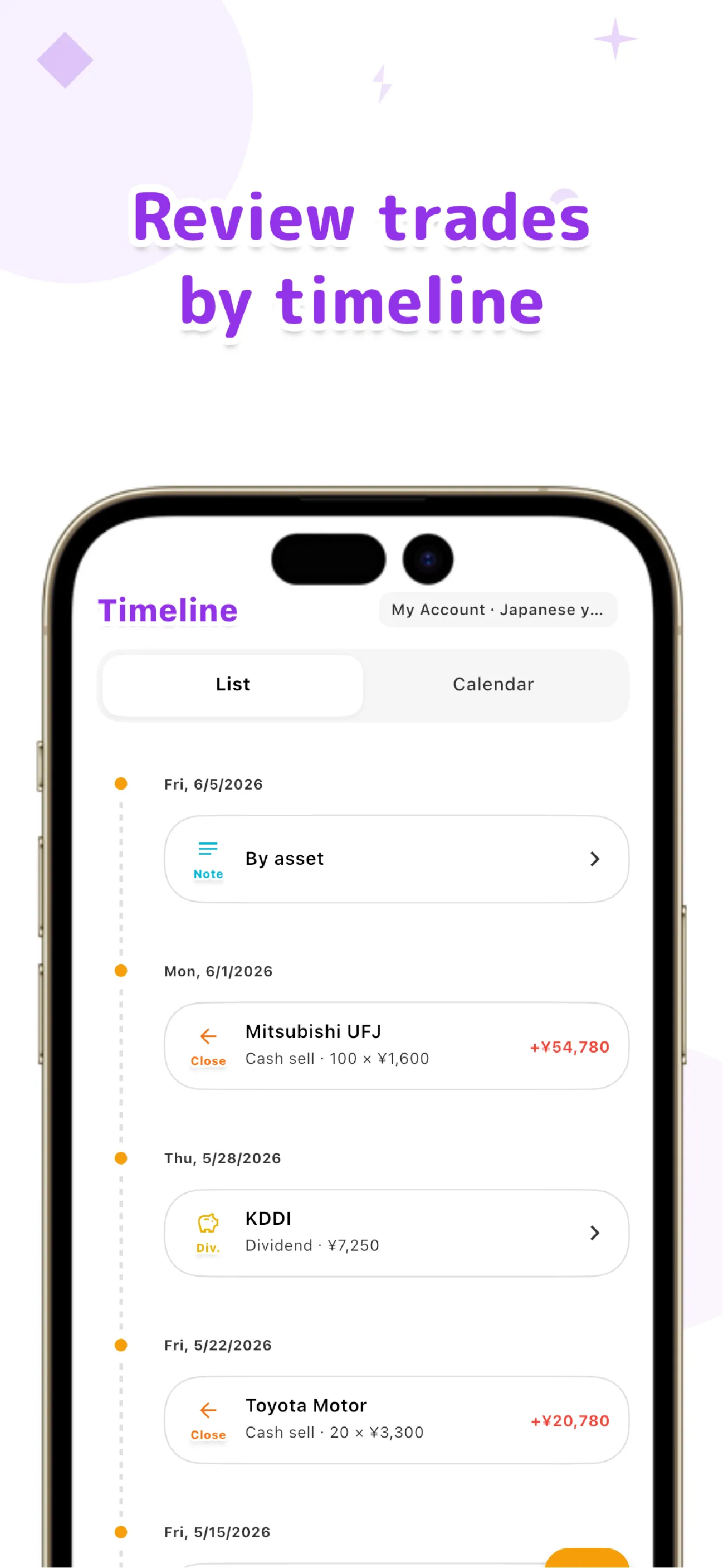
Because buys, sells, dividends, and deposits/withdrawals line up chronologically on the transaction timeline, following a ticker's history at earnings time or when you sell takes you straight back to the note you wrote at the time. Share count, average cost basis, and total cost per holding are all tracked alongside it too, so you never have to look up how to calculate your average cost basis in a separate spreadsheet.
Because realized gains, portfolio value over time, and asset allocation (by ticker, sector, or custom list) are all visible alongside it, you're not managing your investment journal in isolation — you're reviewing your past decisions in the context of your whole portfolio. If you want to go deeper on reviewing individual trades, see our guide to trading journal apps and what to log. For reviewing at the point of sale, our guide to tracking realized gains and annual totals is worth a look too.
Everything you log is local-first, saved on your device first. If you want to sync across multiple devices, the Pro plan's cloud sync sends your data over an encrypted connection. We cover the design decision to never link brokerage accounts in more depth in our guide to portfolio trackers without account linking.
Log your trigger, rationale, expected scenario, and exit condition for every trade
See LiteFolio's trade notes featureYou'll forget why you bought a stock unless you record it, and once it's underwater, that memory tends to get rewritten in your favor. Log your trigger, rationale, expected scenario, and exit condition every time you buy, and reread them at earnings and at the sale, and you'll build a review habit that's harder for emotion to hijack. LiteFolio is a record-keeping and visualization tool and does not provide investment advice.

LiteFolio
A manual-entry investment portfolio tracker that never connects to your brokerage account. Leave a note every time you log a buy, sell, dividend, or deposit, and revisit it later on the transaction timeline. Data is stored local-first. Available now on iOS and Android.
Learn more about LiteFolioFrequently asked questions
What should I actually write in an investment journal?
Start with one line each for "trigger," "rationale," "expected scenario," and "exit condition." It doesn't need to be perfectly written — prioritize jotting it down right after you buy.
Is LiteFolio free to use?
LiteFolio is available now for iOS and Android. Check the App Store or Google Play for current features and pricing.
Can it link to my brokerage account and auto-generate notes?
No. LiteFolio never connects to any brokerage account — it's a manual-entry app. You type in notes like your reason for buying yourself, right when you log a buy or sell.
Can I start journaling now for stocks I bought a while ago?
Absolutely. If your memory of the original reasoning is already hazy, don't force yourself to recall it — write down how you see the position today instead, and start your review habit from today.