The short answer: a household tasks list holds up when it is sorted by how often each task comes back, not by room. Daily tasks take a few minutes each, weekly tasks fill a Saturday morning, and the monthly and seasonal ones are the tasks that quietly get forgotten. Below is a list you can copy, split into those four groups, followed by a way to put a name and a rhythm on each line.
The Koto team here. We build a shared task app for couples and families, so we spend a lot of time looking at the lists people actually write. The lists that keep working tend to share a pattern: they are short, they are grouped by frequency, and every line has an owner. The ones that fade are usually a single 70-item “whole house” list that nobody opens after the first weekend. This article is the first kind of list, written out, plus notes on how to adapt it to your own house.
Koto is a shared to-do list for couples and families. Put each task on a repeat, give it an owner, and see when it’s done. No points, no scoring.
See KotoWhy sort by how often, not by room
Most printable lists are organized by room: kitchen, bathroom, bedroom. It looks tidy, but it hides the thing that decides whether a task gets done, which is the calendar. “Clean the kitchen” could mean wiping the counters tonight or degreasing the range hood this season. Sorting by frequency makes the difference visible. A task that returns every day needs to be small enough to do without thinking. A task that returns every few months needs a reminder, because no one will remember it from the last time.
The times and frequencies below are starting points, not rules. Homes differ in size, in how many people and pets live there, and in what the manual for your appliances says. Treat the list as a draft you edit in the first month.
Daily tasks
Keep this group short. If a daily list passes eight or so lines, something on it probably belongs in the weekly group.
| Task | Notes |
|---|---|
| Dishes, or run and unload the dishwasher | Whoever cooked rarely wants to be the one who cleans; many households split these two jobs |
| Wipe kitchen counters and the stovetop | Two minutes after the last meal |
| Quick tidy of the main living area | Put things back where they live, a basket for the rest |
| Make a plan for tomorrow’s meals | Even “leftovers” counts; it prevents the 5 p.m. scramble |
| Take out the kitchen trash when it’s full | Not necessarily every day; do it when the bag is full |
| Pets: feed, water, check the litter box | Pet care is its own group of chores in many homes |
Weekly tasks
This is the bulk of a household. Many families pick a weekend morning for a shared “reset” and keep a few single-day tasks, like trash and recycling, tied to the days the collection trucks come.
| Task | Notes |
|---|---|
| Take bins to the curb on trash and recycling day | Usually the night before; check your town’s schedule, which can shift around holidays |
| Laundry: wash, dry, fold, put away | Folding and putting away are the parts that tend to be left in the basket |
| Change bed sheets | Many people pick one fixed day, such as Sunday evening |
| Vacuum floors, mop hard floors | Entry and kitchen first if time is short |
| Clean the bathrooms: sink, toilet, shower | The job most people would rather swap than own |
| Wipe down kitchen surfaces and appliance fronts | |
| Grocery trip and restock | A shared grocery list helps; here is how to share one |
| Empty all trash cans; replace liners | |
| Water indoor plants | |
| Quick review of the week ahead | Five minutes, standing in the kitchen, with the list in hand |
Monthly tasks
Monthly tasks are where most lists fail, since a month is long enough to forget and short enough to feel like it’s always due. A common trick is to spread them out, one per week, instead of stacking them all on the first of the month.
| Task | Notes |
|---|---|
| Test smoke and carbon monoxide alarms | Many manufacturers suggest a monthly test; check your model’s manual |
| Check the HVAC or furnace filter | Intervals vary with filter type and with pets and dust, often every one to three months; the label on the filter usually says |
| Clean the refrigerator: toss expired food, wipe shelves | |
| Run a cleaning cycle in the washer and the dishwasher | Check each manual for the right method |
| Wipe baseboards, door frames, light switches | |
| Vacuum under and behind furniture | |
| Clean the garbage disposal, if you have one | |
| Review the pantry and freezer | Use the older items first; make a list of gaps |
| Check the first aid kit and common medicines | Replace what’s expired |
Seasonal and yearly tasks
Seasonal tasks tie to the weather more than to the date, so exact timing depends on where you live. In much of the US, they cluster around spring, fall, and the first hard freeze.
| Task | Notes |
|---|---|
| Clean gutters | Commonly spring and fall; safe ladder use matters more than speed |
| Wash windows and clean window screens | Spring is common |
| Have the air conditioner serviced or check it before summer | Follow the manufacturer’s guidance |
| Reverse ceiling fan direction | Many fans have a switch; counterclockwise in summer, clockwise in winter is a common rule |
| Disconnect and drain outdoor hoses before the first freeze | Protects outdoor spigots from damage in cold climates |
| Check weatherstripping, caulk, and door seals | Fall, before heating season |
| Furnace or heating check | Before the cold season; some people book a professional |
| Flush the water heater | Many manuals suggest once a year; follow your model’s instructions |
| Clean the dryer vent and lint trap duct | Commonly once a year, more often with heavy use |
| Replace smoke and CO alarm batteries | Some families tie this to the daylight saving time changes |
| Snow shoveling and salting walkways | Depends on your climate, and on who has the better back |
| Deep-clean the oven and refrigerator coils |
Turning the list into assignments
A copied list is still just a list until each line has an owner and a rhythm. Go through it with everyone who lives in the house and decide three things for each task. Who owns it. A single owner works better than “we both do it,” because the second one is a way of saying no one does. If a task really can go to anyone, say that on purpose and leave it open. How often it returns. Use the groups above as a start and change them without guilt; a one-person apartment may do the bathroom every two weeks. How long it takes. We’d write a rough guess next to each task. It doesn’t have to be right. What the guess does is make a heavy list visible, so you can move a few things before a person ends up with three hours of Saturday work and the other with thirty minutes.
Two habits make the difference. First, give seasonal tasks to whoever owns that domain, rather than rotating them: the person who handles the garage and yard takes the gutters, the person who handles the kitchen takes the refrigerator coils. Second, review the list once a month for five minutes. Remove what you never do, and move up what you keep skipping, because that’s a sign the frequency is wrong, not the people.
On paper, or on a shared app
Paper has real advantages. A chart on the fridge needs no battery, and everyone sees it every time they reach for the milk. If that suits your household, our free printable chore chart generator turns this list into a page: add up to 8 names, pick from 30 common chores or type your own, choose daily, weekly, or monthly, and print. No points, no scoring, no sign-up. The weak spot of paper is the monthly and seasonal part, which is the tasks nobody sees until they’re overdue.
That is where a shared app earns its place. We built Koto for exactly this handoff: the daily and weekly rhythm stays on the fridge if you like it there, and the tasks that need a nudge go in the app with a repeat and a reminder. In Koto you can start without an account on one phone, then invite your partner with a code. They sign in to join, and free groups support up to 6 people.
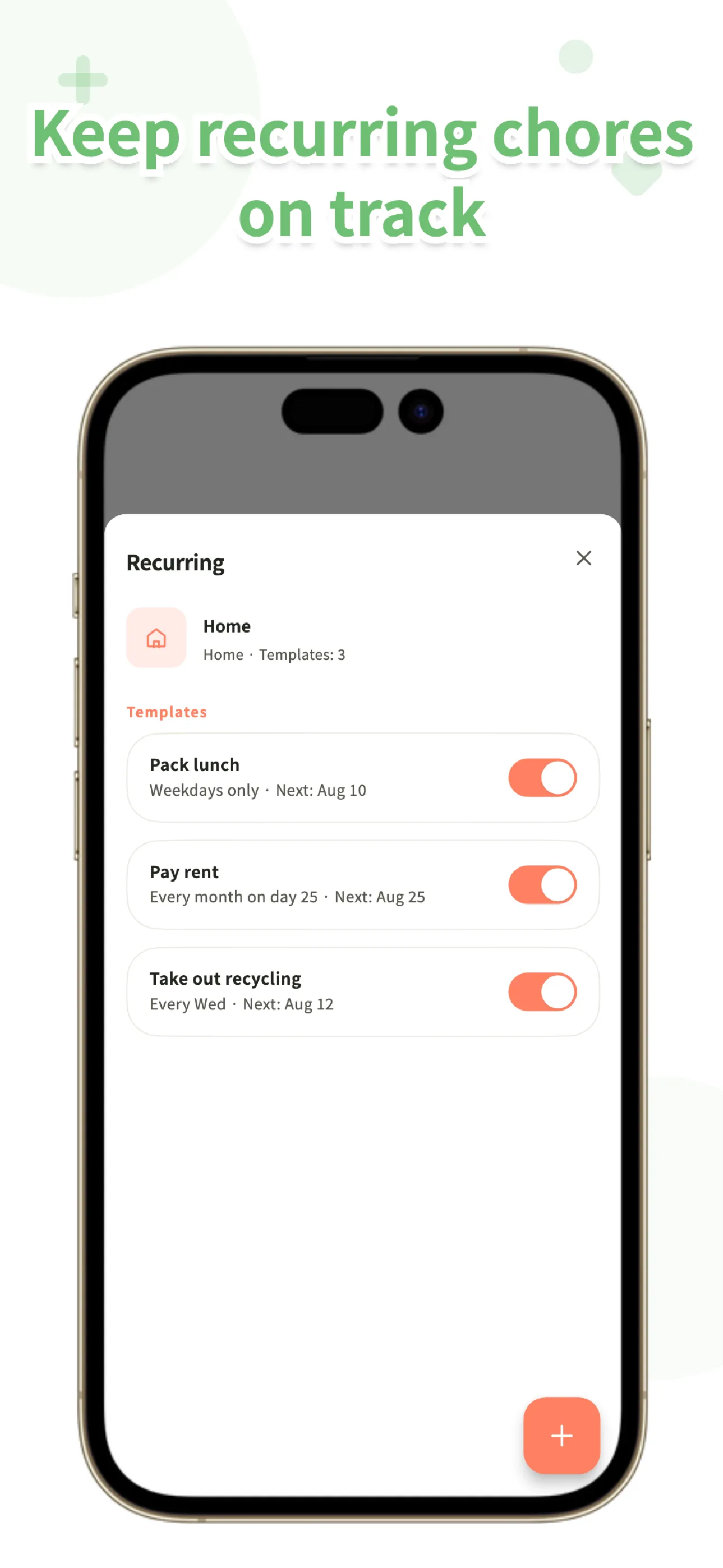
Here is how the list above maps to Koto’s repeats. Weekly tasks repeat on one or several weekdays, so trash and recycling can sit on Tuesday and laundry on Saturday. Monthly tasks repeat on a date or on the Nth or last weekday of the month, which fits “first Saturday: HVAC filter” and “last Friday: refrigerator clean-out.” Other repeat options are every N days, weekdays only, and weekends only. A repeating task carries its assignees and its note forward, so you only write it once. Each task can have one reminder, set as a number of days before the due date at a time you choose, and it fires on your phone even when you’re offline. Due dates are calendar days, not times of day. Make one list, such as “Household,” and add each line from the tables with an owner.

Koto
A shared to-do list for couples and families. Put the weekly and monthly chores on repeat, give each one an owner, and see when it’s done. Works offline. No ads. Free groups support up to 6 people.
Learn more about KotoWhat Koto can’t do for this list
There is no automatic rotation, so a task won’t move from one person to the next each week. If you want to alternate bathrooms, make two tasks, one per person, or change the owner by hand. There is no yearly repeat preset; for annual items, like flushing the water heater, we’d add a task with a due date and add the next one when it’s done, or use “every N days” for quarterly checks. There is no calendar view and no time-of-day schedule, no time estimate field, and no points, because a household tasks list shouldn’t double as a scoreboard. If you’re still deciding which kind of app suits your home, our checklist in Household Chores App: What to Check Before You Pick One goes through the questions in more depth than we will here.
Frequently asked questions
What should be on a household tasks list?
Group tasks by how often they return. Daily tasks include dishes, wiping counters, and a quick tidy. Weekly tasks include laundry, vacuuming, bathrooms, trash and recycling day, and groceries. Monthly tasks include testing alarms and checking the HVAC filter, and seasonal tasks include gutters, outdoor hoses, and weatherstripping. Adjust the groups to your home, climate, and who lives there.
How do we decide who does which household task?
Go through the list together and give each task a single owner, a frequency, and a rough time estimate. Compare the totals so one person doesn’t carry the heaviest tasks every week. Give seasonal tasks to whoever already handles that part of the house, and review the list after a month.
How often should I check the HVAC filter and smoke alarms?
Many manufacturers suggest testing smoke and carbon monoxide alarms monthly, and furnace or HVAC filters are often checked every one to three months. The right interval depends on your model and on pets and dust, so follow the manual or the label on the filter.
Should I keep a household tasks list on paper or in an app?
Either works. Paper is visible without a phone, and our free chore chart generator prints one with no sign-up. An app helps with monthly and seasonal tasks because it can repeat them and remind you. Many households use paper for daily and weekly tasks and an app for the rest.
Koto
Put your household tasks list on both phones. Free groups support up to 6 people. No ads, no points. Available now on the App Store and Google Play.
Learn more about Koto