We're the team behind VSPocket. We build games two people play face-to-face on a single phone, and Connect Four was one of our picks. What mattered when choosing it was simple: can someone who doesn't know the rules sit down and play a round right away? Connect Four — just dropping discs, yet a deep read of each other — fit that bar perfectly.
This article explains the rules so a first-timer can follow along, then shares the winning tips we picked up from playing it over and over.
What Connect Four is
Connect Four is played on an upright grid of 7 columns by 6 rows, where two players take turns dropping their colored discs. A disc falls by gravity to the lowest empty cell. Whoever first lines up four in a row — vertically, horizontally, or diagonally — wins. If the board fills with no four in a row, it's a draw. A round usually takes 3–10 minutes.
It resembles Gomoku, but with one decisive difference: you can't place anywhere. A disc always falls to the bottom of a column, so your options are always limited. That very constraint is what gives Connect Four its unique strategy.
In VSPocket, tapping a column at the bottom of the screen drops a disc. There's no board to set up or pack away, so you can start a round the instant you feel like it. No internet either, so you can play on a trip or while waiting.
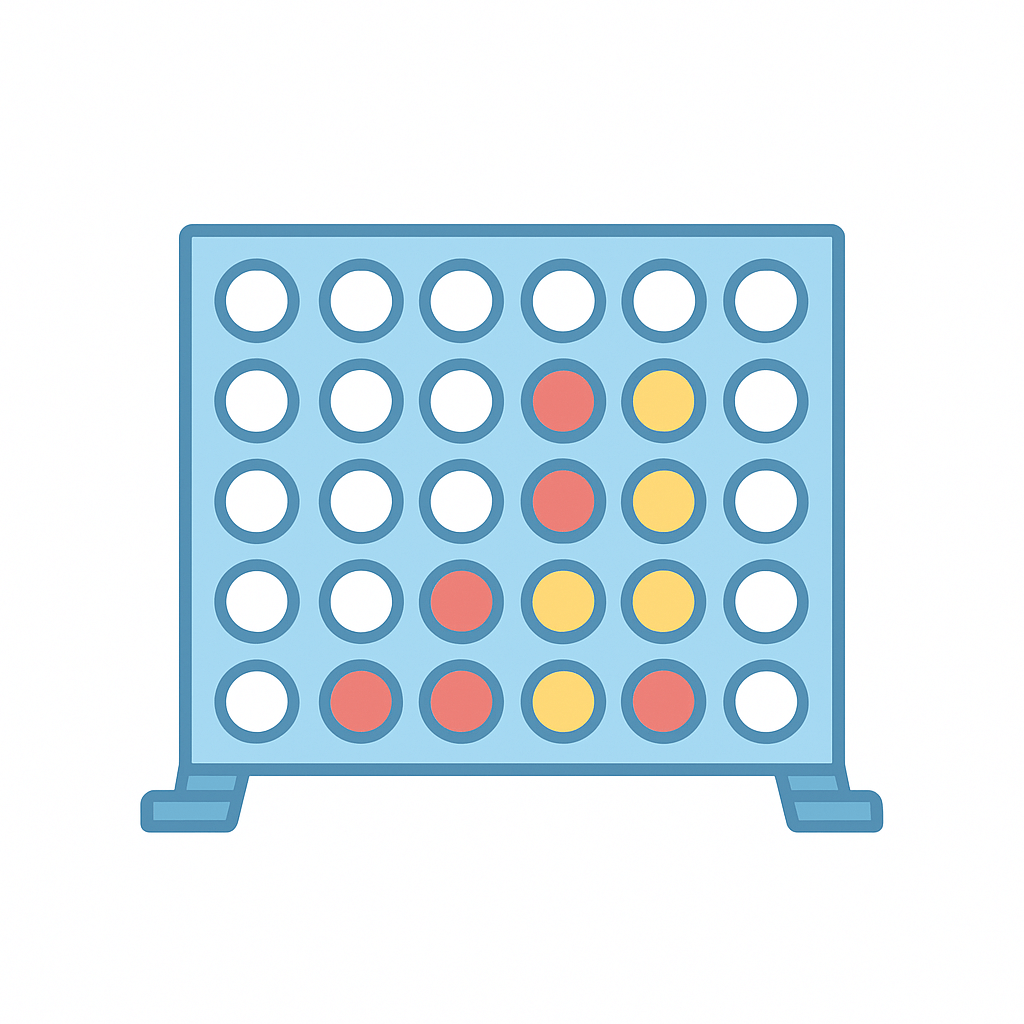
First, take the center
The first thing we felt from playing round after round was the strength of the center column. The center touches the most four-in-a-row lines of any cell. Control it and both your attack and defense get much stronger. As the first player, open in the center without hesitation — that's step one in Connect Four.
Games are decided by the double threat
Almost every win comes the moment you threaten two spots at once. Make two three-in-a-rows in a single move and the opponent can only block one; the other completes your four. Conversely, the heart of defense is not letting them set up that shape. You could say improving at Connect Four comes down entirely to the battle of "make a double threat / don't allow one."
So if the opponent has three in a row about to become four, hold back the urge to attack and cap that column first. Not losing comes first; chasing the win comes after.
Once comfortable, mind odd and even
Going a step further, there's a deeper theory in which the parity of the row where you build a threat sways the result. Roughly: the first player tends to do well with threats on odd rows (1st, 3rd, 5th from the bottom), the second on even rows. Center and double threat are plenty to win at first, but start minding this and your win rate climbs another notch.
Play Connect Four on VSPocket
VSPocket is an offline collection of board games two people play face-to-face on one phone. Along with Connect Four, you can play Shogi, Chess, Reversi, Tic-Tac-Toe, and Gomoku in the same app. Free, no sign-up, ready to play the moment you open it. Mind the center and the double threat — and play a round with the person next to you.

VSPocket
An offline collection of board games two people play face-to-face on one phone. Connect Four included. Free to start.
Learn more about VSPocketFrequently asked questions
How many in a row do you need to win Connect Four?
Four of your discs in a row — vertically, horizontally, or diagonally. Since discs fall by gravity, placement is limited, which is the game's signature feature.
Is the first or second player favored?
In theory the first player is favored and gains an edge by taking the center column first. With accurate play, though, the second player can hold their own.
Can it end in a draw?
Yes. If all 42 cells (7×6) fill and neither side has four in a row, the game is a draw.
How is it different from Gomoku?
In Gomoku you place a stone anywhere on the board, but in Connect Four discs fall by gravity, so you can only fill the lowest empty cell of each column. That constraint creates its unique strategy.